Use the Sunbelt Rentals App
Find, rent, and return equipment, right at your fingertips

What You’ll Learn About Dehumidification Systems on This Page
How Do I Choose a Dehumidifier?
Choosing the right dehumidifier comes down to capacity, performance, and reliability. Commercial units are designed for continuous operation in large, heavily saturated spaces, while residential versions lack the airflow, moisture removal rate, or automation needed to meet site demands.
Moisture impacts construction timelines, damages critical materials, creates mold hazards, and reduces energy efficiency across facilities. It can derail compliance in pharmaceutical manufacturing, spoil warehouse inventory, or ruin specialized coatings. Without a purpose-built dehumidification system, drying times stretch, costs rise, and results fall short.
Sunbelt Rentals helps facility managers, restoration teams, and contractors select and deploy the correct commercial dehumidification units, backed by delivery, setup, and 24/7 support.
The Importance of Commercial Dehumidification Systems
Controlling moisture protects materials, equipment, and the people working inside a space. A dehumidification system lowers relative humidity (RH), maintains dew point, and allows other work—like coating, painting, or flooring—to proceed on schedule.
Common environments that require robust commercial dehumidifiers include:
- Warehouses storing paper goods, textiles, electronics, or raw materials
- Industrial process floors that require temperature and humidity stability
- Construction sites drying gypsum concrete or drywall
- Data centers and archive rooms with strict air quality needs
- Flooded buildings needing full recovery before reopening
A commercial dehumidifier use case often overlaps with temperature control, ventilation needs, and compliance requirements. An integrated approach improves safety, prevents material degradation, and keeps operations moving.
What Are the Different Types of Industrial Dehumidifiers?
Refrigerant Dehumidifiers
Refrigerant systems remove moisture by condensing vapor on a cooled coil. They’re easy to set up and ideal for higher temperature environments, especially when ambient humidity is moderate to high. These are the most commonly rented commercial dehumidifiers for large spaces like warehouses or offices. These come in many shapes and sizes. Small to very large tonnage air conditioners to low-grain refrigerant options for low ambient temperatures.
Desiccant Dehumidifiers
Industrial desiccant dehumidifiers use a rotating desiccant wheel to absorb moisture from the air. These units function effectively in very low-temperatures or low-humidity conditions. They deliver ultra-low dew points and are essential in pharmaceutical manufacturing, cold storage, and specialty coatings. These are also the preferred methods of dehumidification when moisture removal is needed from dense structures or materials, such as concrete drying or curing.
Hybrid Systems
Hybrid dehumidifiers use mechanical cooling and desiccant rotors in tandem. They’re suitable for mixed environments where both temperature and RH must be controlled. Hybrid systems balance efficiency with performance and are well-suited for large-scale restoration, food processing, and warehouse dehumidification. It is optimal for desiccant-level drying, but it must be operated in high ambient environments and in occupied structures to manage temperature increases as a byproduct of the desiccant reactivation process.
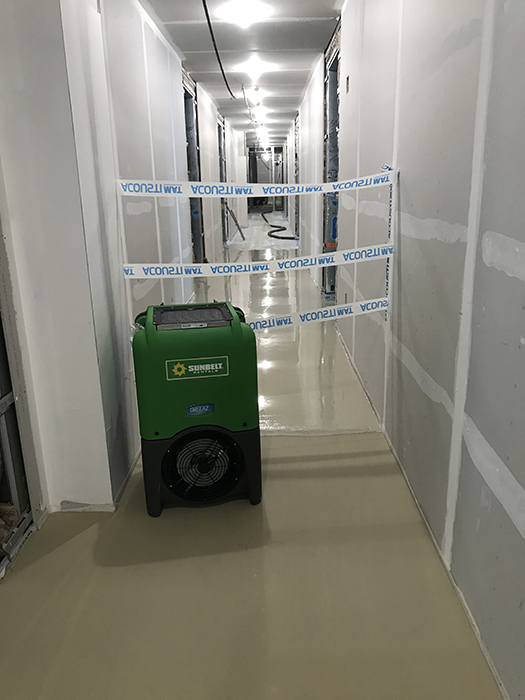
Commercial Dehumidifier Use Cases
Construction Drying
Commercial dehumidifiers help keep concrete, drywall, and flooring projects on schedule by controlling ambient humidity and preventing moisture buildup. For gypsum concrete applications, especially, drying time is everything. Many construction processes have transitioned to more environmentally friendly, water-based adhesives, paints, and glues. This results in excess moisture being released into the space, slowing residual drying and stalling curing processes.
Coating Operations
Surface coatings require precise dew point control. Commercial dehumidifiers are commonly used in epoxy flooring, paint booths, tank lining, and any project where finish quality can be compromised by excess humidity. Surface preparation and blasting can expose raw metal. Temperature swings and dew point fluctuation can result in condensation on prepped surfaces, resulting in flash-rusting. Protecting from humidity exposure is critical.
Gypsum Concrete
Gypsum mixes are highly sensitive to environmental conditions. If humidity rises above the target, gypsum will crack, cure unevenly, or stall entirely. A properly sized industrial dehumidifier provides the continuous performance necessary to meet timelines.
Humidity Control
From museums to data centers, environmental control is critical. A dehumidifier for industrial use maintains optimal RH across spaces that store sensitive materials or house precision equipment.
Industrial Processes
Industrial dehumidifiers are used in manufacturing environments to prevent condensation, reduce contamination risk, and stabilize air conditions for repeatable outcomes. These systems support powder handling, curing, injection molding, and packaging.
Manufacturing Processes
Many factories rely on controlled humidity for processes like bonding, baking, or welding. Our industrial dehumidifier for warehouse systems delivers steady airflow, stable temperatures, and reliable moisture removal across wide square footage.
Warehouse Storage
Warehouse dehumidification helps safeguard paper stock, textiles, electronics, and other moisture-sensitive inventory. Commercial ducted dehumidifier units are often integrated with HVAC systems for long-term performance.
Property Damage Restoration
After a flood or pipe burst, fast drying matters. Commercial dehumidifier simplify setup, while carpet dryers, air movers, and dehumidifiers work together to reduce moisture levels before mold develops.
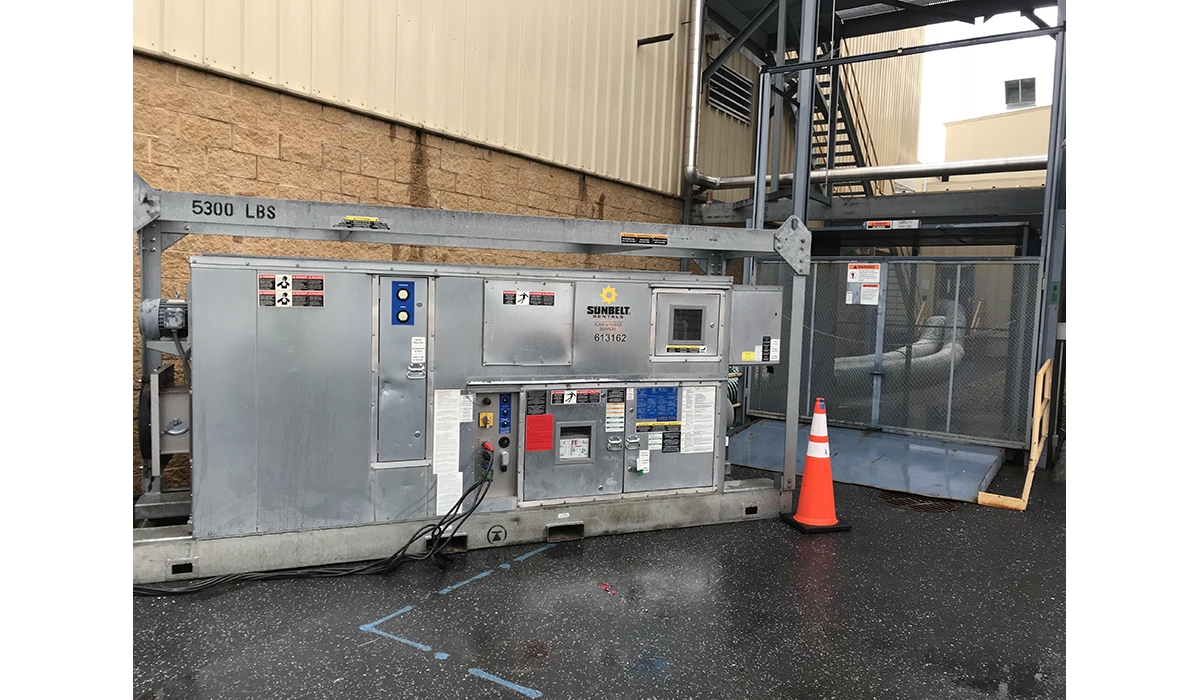
Key Considerations for Choosing a Commercial Dehumidifier
Size
Determining dehumidifier size involves more than square footage. You’ll need to calculate total air volume, assess the existing moisture load, consider heat generation from equipment, and factor in infiltration rates.
On large jobs, multiple units are often configured in parallel. If you're unsure about commercial dehumidifier sizing, our experts provide application-specific recommendations that consider runtime, ambient conditions, and load balancing across zones.
Energy Efficiency
Not all commercial dehumidifiers draw power equally. For temporary use, efficiency may take a back seat to throughput. But in longer-term applications, energy consumption quickly becomes a budget line item.
Look for units with variable-speed blowers, staged operation, or energy recovery features. When energy audits are part of the requirement—as in LEED buildings or sustainability reports—energy-efficient dehumidifiers help meet performance targets.
Extraction Rate
Extraction rate defines the volume of moisture removed, typically measured in gallons or pints per 24-hour cycle. A dehumidifier for a large space often requires 100+ gallons per day.
For example, a commercial portable dehumidifier in a flood-damaged school may need to maintain 200 pints/day extraction for three to five days. Keep in mind that temperature and humidity impact extraction efficiency—cold, dry environments require different tech than warm, humid ones.
Dew Point & Temperature Range
Temperature shifts create new risk factors. In refrigerated spaces, ice can form on refrigerant coils, halting moisture removal. In pharmaceutical environments, failure to maintain dew point tolerance can void compliance. This is where industrial desiccant dehumidifier models shine.
They’re engineered for extreme conditions, including freezing temperatures, and perform well in vacuum-sealed or inert environments. Some hybrid models are also rated to deliver stable performance across variable temperature zones, from -10°F to 95°F.
Drainage Options
For unattended or remote projects, drainage must be automated. A commercial dehumidifier with pump helps maintain continuous operation by routing condensate vertically or over long distances. Drainage matters most in water damage recovery, unmanned mechanical rooms, and overnight jobs where overflow would delay progress or damage equipment.
Humidity Control
Many commercial dehumidification systems now integrate sensor ports and onboard humidistats. For enterprise-level projects, remote data capture and alerts can flag issues before they escalate.
Our Wireless Monitoring System helps clients monitor RH, dew point, and temperature remotely—ideal for large-scale warehouse dehumidification or specialty environments where compliance is monitored in real-time.
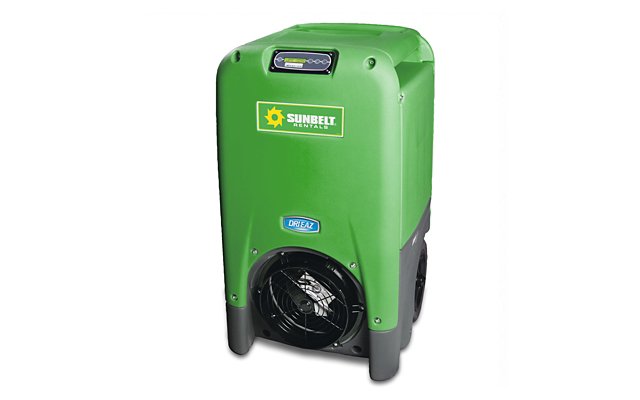
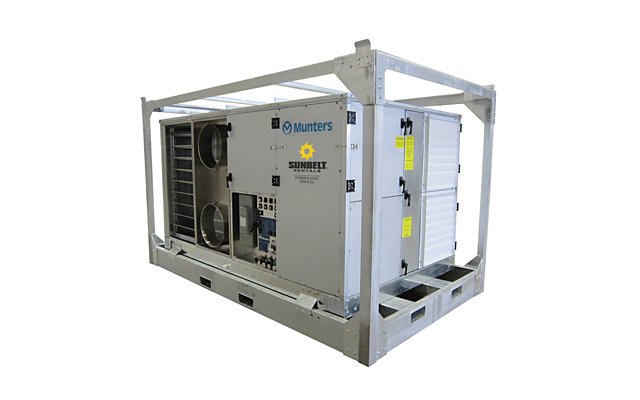
This refrigerant model handles up to 25 gallons per day and is designed for large spaces requiring rapid moisture removal. It’s widely used for drying drywall, slabs, and saturated interiors.
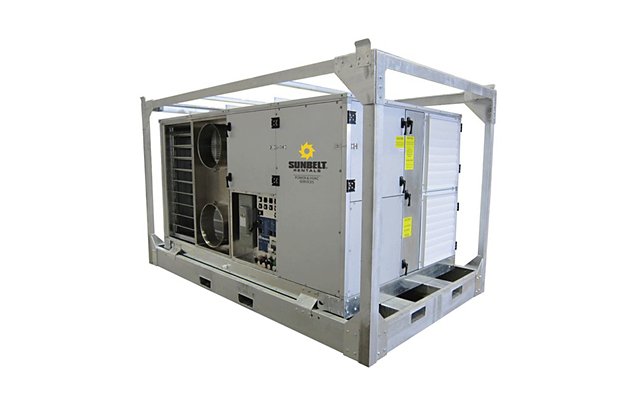
A tri-fuel, high-capacity desiccant system engineered for extreme dew point reduction. It performs reliably in freezing conditions, vacuum-sealed rooms, and pharma-grade environments.
Combines desiccant drying with mechanical cooling, making it ideal for mixed environments. Highly effective in food production, clean rooms, and multi-stage drying operations.
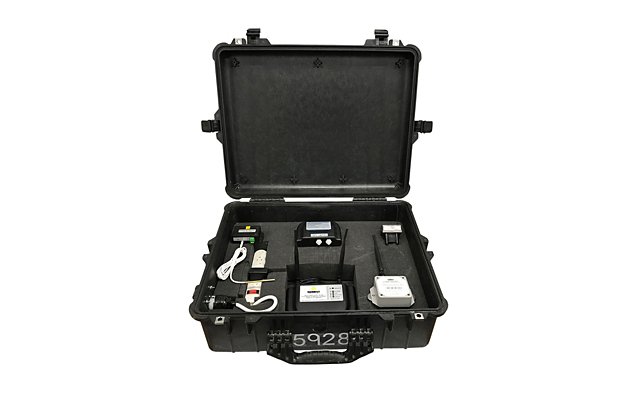
Tracks temperature, RH, and dew point from anywhere, with real-time alerts. Particularly valuable in regulated spaces like warehouse dehumidification or clean manufacturing.
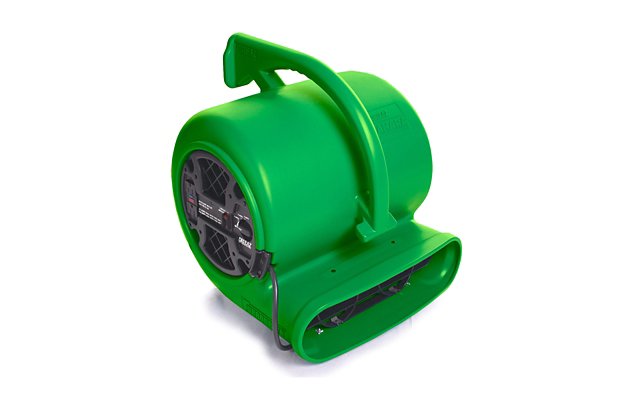
Moves high volumes of air to accelerate evaporation. Often used alongside dehumidifiers in restoration settings, water recovery jobs, or time-sensitive drying work.
Understanding Industrial Dehumidifier Specifications
Making the right rental choice means knowing how to evaluate performance specifications. Each of the following five criteria plays a critical role:
Airflow (CFM)
High airflow improves circulation and speeds up drying. Small units handle 300–500 CFM, while large trailer-mounted systems may exceed 10,000 CFM. Choose airflow volume based on space size and saturation.
Extraction Rate
Most commercial units remove 10–30 gallons per day per unit. Multiple units may meet portability and power availability on-site for large applications. Industrial-size dehumidifiers can exceed 300 gallons/day. For example, at 80°F and 60% RH, a desiccant system can operate continuously to maintain strict environmental targets.
Power Requirements
Entry-level dehumidifiers use 115V or 230V outlets. Larger refrigerant or hybrid models may require 480V 3-phase power and a dedicated generator or panel. Always match your site’s power to the unit’s draw.
Setup and Transport
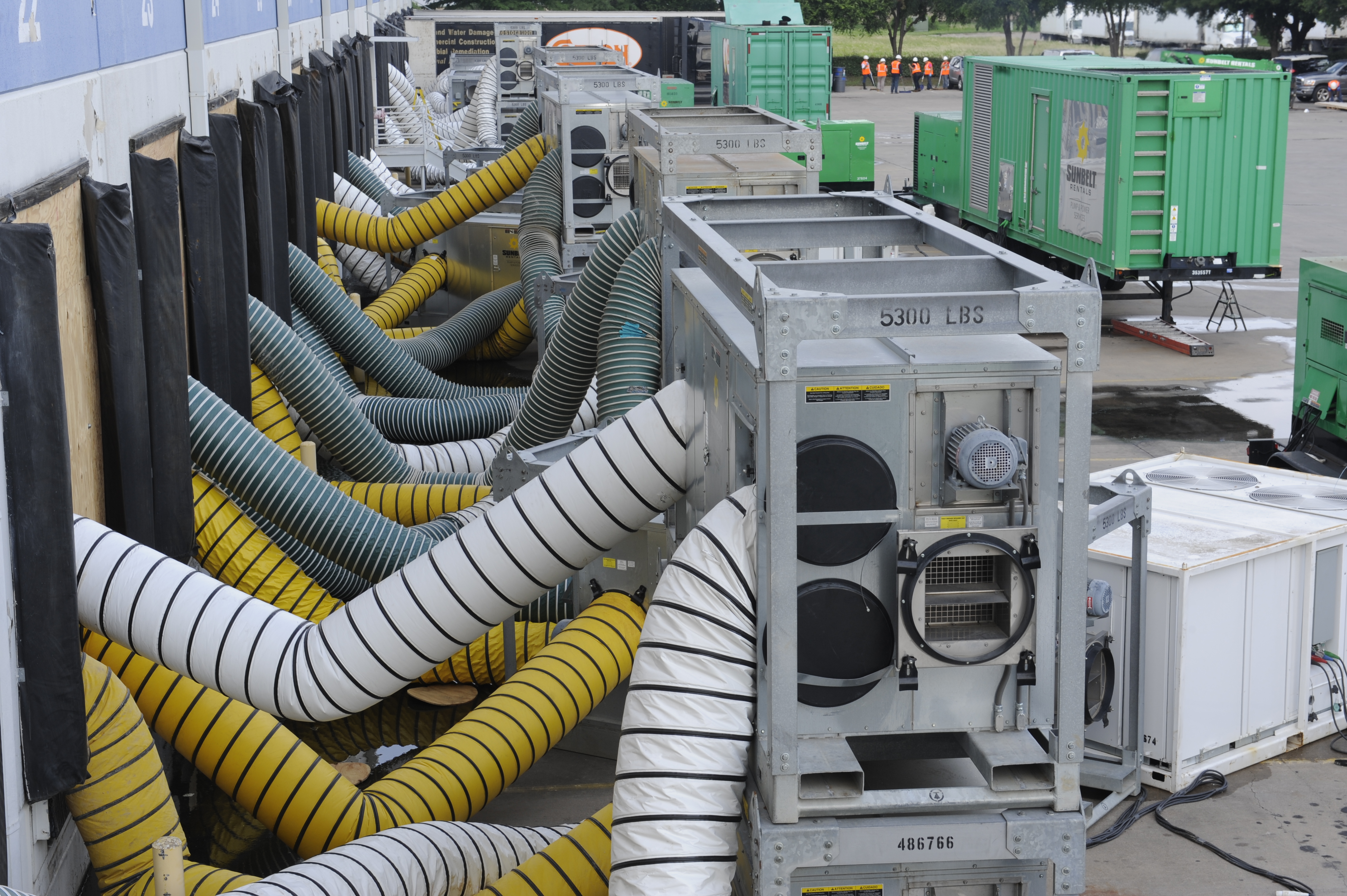
Smaller units include caster mounts or wheeled frames. Larger machines may be skid-mounted or trailer-based, requiring forklifts or lift plans. Delivery and setup services help mitigate time loss and safety risks.
Controls and Monitoring
Look for built-in humidistats, automated shutoffs, and data logging. Remote access systems like SAMS make it easier to meet compliance and track site performance without round-the-clock staff.
Find the Best Dehumidifier for Your Operation
Dehumidification planning should start early in any commercial or industrial project. Calculating RH goals, ambient conditions, and extraction rates helps you determine the right type of dehumidifier—whether that’s refrigerant, desiccant, or a hybrid model.
At Sunbelt Rentals, we provide:
- Customized rental recommendations based on application, square footage, and runtime
- Access to industrial dehumidifiers engineered for every industry
- Air monitoring systems for real-time condition tracking
- 24/7 expert support and delivery nationwide
Browse our Climate Control catalog or connect with a local rep for help configuring your next dehumidification solution.
Why Choose Sunbelt Rentals?
Sunbelt Rentals brings more than just equipment—we bring partnership. Our Climate Control Services team supports:
- FDA-regulated cleanrooms requiring tightly controlled humidity
- Construction projects racing to meet finish schedules after rain delays
- Food and beverage processors working toward precise dew point targets
- Water remediation crews responding to burst pipes, floods, and fire damage
- Industrial manufacturing lines reliant on dry environments for quality outcomes
With availability across North America and fast-turnaround delivery, we help you solve challenges on your timeline, not ours.